Steps to Legally Marry in Italy

Legal Requirements for Non-Italian Citizens
To legally marry in Italy as a foreign couple, you need a civil ceremony at the town hall. Religious ceremonies can follow but are not legally binding. Make sure your documents are translated and legalized.
- Passports: Valid passports for both partners.
- Birth Certificates: Official, translated, and legalized with Apostille.
- Certificate of No Impediment (CNI / Nulla Osta): Must be translated and legalized.
- Divorce / Death Certificates: Legal proof of previous marriage status.
- Declaration of Marital Intent: Some municipalities require a sworn declaration.
Steps to Legally Marry in Italy
- Choose your venue and set your date: Book your ceremony at a municipio or private villa. Civil ceremonies are mandatory for legal recognition.
- Gather all required legal documents: Prepare them 3–6 months in advance, translated and legalized.
- Submit paperwork to the local town hall.
- Publication of banns (“Pubblicazioni di matrimonio”): A 2-8 day waiting period may be required.
- Hold the civil ceremony with a municipal official (only state-authorized clergy can make it legal).
- Obtain your marriage certificate and request the international version for legal recognition abroad
Optional: Religious or Symbolic Ceremonies
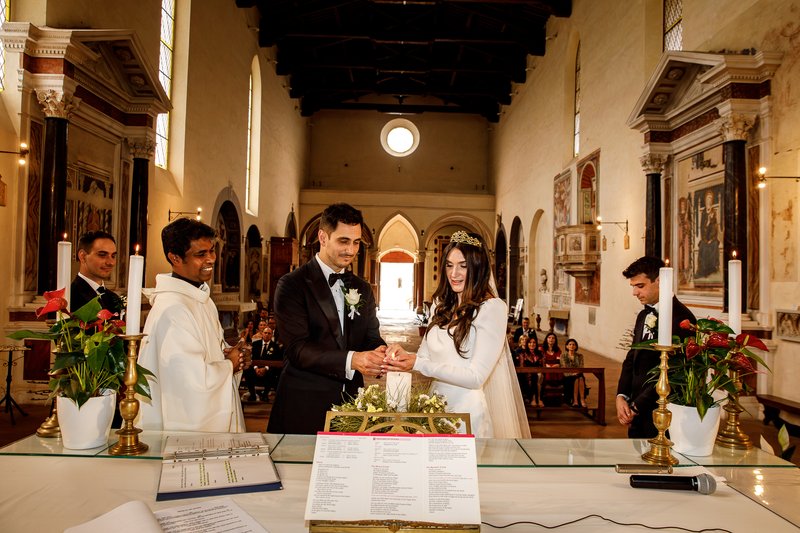
Catholic Weddings in Italy
A Catholic wedding in Italy is both romantic and sacred — imagine saying your vows in Ognissanti Church, Florence or Sant’Agostino, San Gimignano. English-speaking priests often assist international couples.
Marriage is a beautiful sacrament. This guide simplifies your planning and documentation so you can focus on the spiritual and emotional essence of your union. Both your home diocese and the diocese in Italy are accustomed to assisting couples marrying abroad.
Church & Civil Requirements
Even though the Catholic ceremony sanctifies your marriage, a civil ceremony is required for legal recognition in Italy. You may complete this process in your home country or through your Embassy or Consulate in Italy.
Step-by-Step Guide to a Catholic Wedding
- Consult your local parish priest. Begin by meeting your parish priest to express your intention to marry abroad.
- Complete the prenuptial inquiry. Your priest will guide you through a formal inquiry and interviews
- Prepare sacramental certificates and attend Pre-Cana: Obtain Baptism and Confirmation certificates issued within 6 months, Attend a Pre-Cana marriage preparation program
- Obtain letter of delegation and civil documents: This letter allows an Italian priest to officiate your wedding on behalf of your parish.
- Coordinate with the Italian celebrant. Include proof of civil marriage or initiate the process through your Embassy or Consulate. Provide Identity documents for
- Publications of Marriage Intent (Pubblicazioni):The local diocese posts a public notice of your intent to marry.
- Provide Witness Testimonies:Your parish will confirm your chosen witnesses to complete the registry forms.
- Coordinate with the Celebrant in Italy:Plan readings, music, and review your ceremony booklet during 2–3 virtual or in-person meetings.
- Rehearse the Ceremony: A final rehearsal ensures all details are perfect for your big day.
- Celebrate the Marriage: Exchange your vows in your chosen church, surrounded by family and friends.
- Sign the Registry: After the ceremony, you and your witnesses sign the official registry for canonical and civil validation.
Most Italian parishes are familiar with destination weddings and will handle your paperwork with grace. Whether in Florence, San Gimignano, or a countryside chapel — your Italian Catholic wedding will be unforgettable.
Symbolic Ceremonies in Tuscany
Symbolic weddings are intimate and emotional — no paperwork, only love. Celebrate freely in vineyards, villas, or beaches with personalized vows, music, and rituals.


Commenti
Posta un commento